Opinion Piece.
In an era defined by rapid technological advancement, cross-border mobility, and widening socio-economic gaps, the question facing South Africa is not merely whether our students can compete globally but whether our education system equips them to critically and creatively shape that global future.
According to the 2021 Progress in International Reading Literacy Study (PIRLS released in 2023), 81% of Grade 4 learners in South Africa cannot read for meaning in any language, a sobering statistic that puts our education system at odds with international literacy benchmarks. South Africa ranked last out of 57 countries. These outcomes expose structural inequalities and the deep scars of apartheid-era education systems that still disadvantage the majority. DBE statistics confirm this, with over 17,000 (70%) public schools not having libraries, and more than two-thirds of them unstocked. Yet, while the challenges are stark, they are not insurmountable.
Globally, we are witnessing a strong trend toward interdisciplinary, competency-based education where adaptability, emotional intelligence, digital literacy, and critical thinking are increasingly valued. Universities and institutions are realigning curricula to focus on skills that transcend rote memorization. South Africa, in pockets, is aligning with this. The University of Cape Town, for instance, ranked in the top 200 of the Times Higher Education World University Rankings 2025, reflecting some degree of global competitiveness. Stellenbosch University has also emerged as a leader in competence-based and interdisciplinary education, with initiatives like the School for Data Science and Computational Thinking, which brings together faculties across science, engineering, social science, and health to address complex, real-world problems through transdisciplinary learning. Meanwhile, Technical and Vocational Education and Training (TVET) colleges are being reinvigorated as alternative pathways to work readiness, although significant quality gaps remain.
A growing number of South African students are also pursuing internationally recognised qualifications either through partnerships with global institutions or through fully online accredited programs. However, this global access often mirrors our domestic inequalities: it is the wealthy who can afford Cambridge International, International Baccalaureate, or offshore degrees, while under-resourced public schools struggle with basic infrastructure.
To respond meaningfully, we must reimagine education not simply as a means to global competitiveness, but as a site of transformation. The “banking model” of education, where knowledge is deposited into passive students, is long outdated, and schools looking to prepare their scholars must foster dialogical, problem-posing and critically conscious scholars through their curriculum and teaching. Educators, while following set curriculums, need to play an active role in how it is learning occurs. In our context, preparing for the global future must mean empowering students to challenge unjust structures both locally and globally.
True alignment with international standards must not mean mimicry it must mean relevance, equity, and agency. Preparing South African students for the global future requires an education system that is both scientifically robust and socially just: one that ensures a rural learner with a tablet and solar charger can access the same intellectual horizons as an urban learner with fibre internet and private tutors.
We must teach coding and quantum computing, yes, but also ethics, empathy, and civic responsibility. Only then will our students not just compete globally but lead it with integrity.
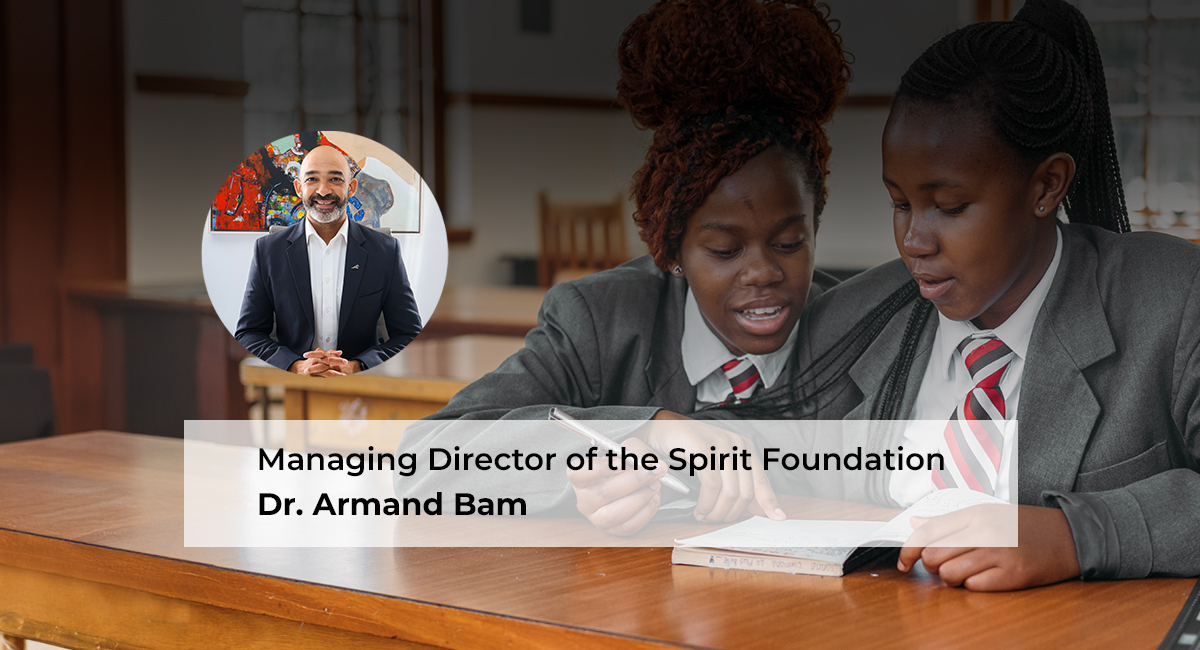
Dr Armand Bam
Director
Spirit Foundation